Can you name a country that has cast a global spell in a surprisingly short amount of time? It is a place where tradition meets futuristic technology, and pop culture has taken over the world. Yes, we are talking about South Korea!
Thanks to Hallyu, or the “Korean Wave,” the letter ‘K’ has become a symbol of cool. From the infectious beats of K-Pop and the gripping storylines of K-Dramas to the delicious explosion of flavors in Korean BBQ, South Korean culture has captured hearts globally.
With South Korea Liberation Day (Gwangbokjeol) approaching on August 15th, there is no better time to dive deeper into this fascinating peninsula. This holiday celebrates the nation’s liberation from colonial rule in 1945 and is the perfect opportunity to teach children about history, resilience, and culture.
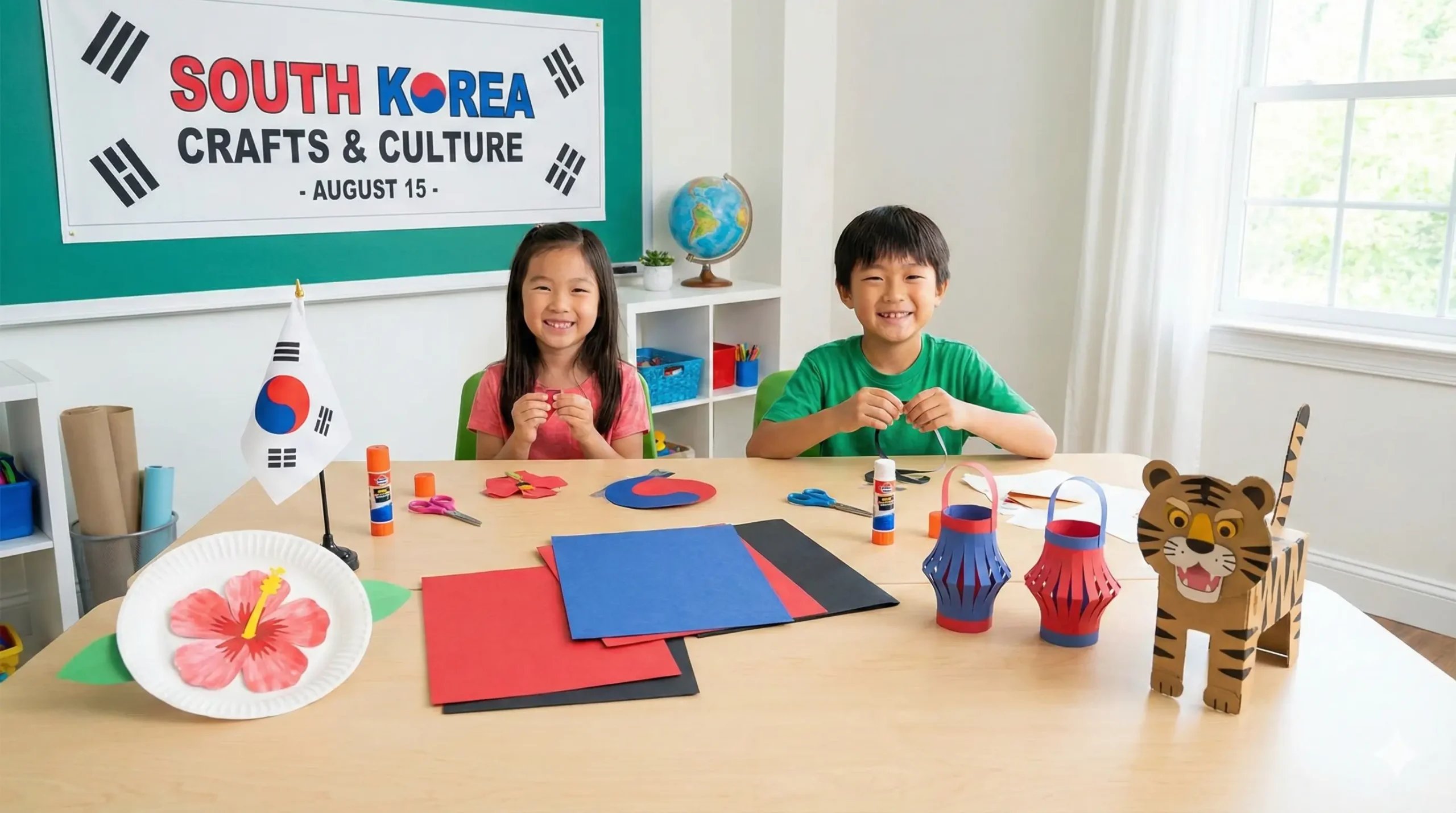
Below, we have curated 10 Sweet and Simple South Korea Crafts for Kids. These activities go beyond just “gluing and pasting”; they are gateways to learning about Korean history, symbols, and traditions.
Fun Facts About South Korea to Share with Kids
Before we get the glue sticks out, let’s set the scene with some trivia. These facts help children understand why they are making these crafts.
- The Name: The word “Korea” comes from Goryeo, the name of a dynasty that ruled the peninsula for centuries.
- A Connected Nation: 93% of Koreans use the internet, and the country boasts the fastest free Wi-Fi networks in the world. You can even get Wi-Fi on hiking trails!
- The Name Game: Nearly 10 million Koreans have the surname ‘Kim’. That is roughly 20% of the population! Other common names include Lee and Park.
- Shopping Giant: South Korea is home to the Shinsegae Centum City, officially the largest department store in the world, spanning over 3 million square feet.
- Red Ink Superstition: Never write a Korean person’s name in red ink! Traditionally, red ink was used to record the names of the deceased, so using it for the living is considered bad luck.
- The Age System: In Korea, you are considered one year old the moment you are born, and everyone turns a year older on New Year’s Day, regardless of their actual birthday!
Now that we are experts on the basics, let’s get crafting!
1. The Taegeukgi (National Flag) Collage
The South Korean flag is full of deep philosophical meaning, making it a great starting point.
- The Lesson: The white background represents peace and purity. The center circle is the Taegeuk (yin and yang), representing balance in the universe. The four black trigrams in the corners stand for Heaven, Earth, Water, and Fire.
- The Craft:
- Materials: White cardstock, red and blue paper, black markers or black electrical tape.
- Instructions: Cut a large circle in the center. Fill the top half with red paper and the bottom with blue in a wave pattern. Use black tape to create the trigrams in the four corners (make sure to look up the specific pattern of broken and unbroken bars!). This teaches symmetry and symbolism.
2. Paper Plate Hibiscus (Mugunghwa)
Every country has a national flower, and for South Korea, it is the Mugunghwa (Rose of Sharon).
- The Lesson: Mugung means “eternity” or “inexhaustible abundance.” This flower symbolizes the enduring spirit of the Korean people.
- The Craft:
- Materials: Paper plates, pink paint, red markers, yellow pom-poms.
- Instructions: Cut the paper plate into a five-petal flower shape. Paint the petals a soft pink. Color the center of the flower red to give it depth, and glue a yellow pom-pom in the middle for the stamen. These look beautiful when pinned to a bulletin board.
3. Traditional Paper Fans (Buchae)
Korean traditional dance often involves beautiful, hand-painted fans.
- The Lesson: The Buchaechum (Fan Dance) is one of the most iconic traditional dances, where dancers use large fans to create shapes like flowers and waves.
- The Craft:
- Materials: Large paper, watercolors, two popsicle sticks.
- Instructions: Cut a long strip of paper. Let the kids paint traditional Korean motifs like cranes, lotus flowers, or cherry blossoms. Once dry, accordion-fold the paper. Glue popsicle sticks to the outer edges to create handles. When opened, it reveals the beautiful artwork.
4. Origami Hanbok
The Hanbok is the traditional attire worn during festivals and celebrations.
- The Lesson: The Hanbok is characterized by vibrant colors and simple lines without pockets. It is worn during Chuseok (Thanksgiving) and Seollal (New Year).
- The Craft:
- Materials: Square origami paper (patterned paper works best).
- Instructions: Origami Hanboks are a classic activity. You fold the top (Jeogori) and the skirt (Chima) separately. The “Chima” is a simple bell shape, while the jacket involves folding the sleeves to create a distinct V-neck. Glue the two pieces together to create a flat paper doll outfit.
5. Lotus Lanterns for Buddha’s Birthday
Buddhism is a major religion in Korea, and the Lotus Lantern Festival is a sight to behold.
- The Lesson: The lotus flower grows in muddy water but blooms cleanly and beautifully. It represents wisdom and purity.
- The Craft:
- Materials: Paper cups, colored tissue paper (pink, purple, white), glue, battery-operated tea light.
- Instructions: Cut the tissue paper into petal shapes. Turn the paper cup upside down. Start gluing the petals from the bottom (rim) of the cup, layering them upwards until the cup is covered. Place the tea light underneath to see it glow!
6. The Korean Tiger Puppet
The tiger is to Korea what the Bald Eagle is to the USA.
- The Lesson: Tigers appear frequently in Korean folklore and paintings. They were once thought to drive away evil spirits and bring good luck. The mascot of the 1988 Seoul Olympics was a tiger!
- The Craft:
- Materials: Orange paper lunch bags, black markers, construction paper.
- Instructions: Use the flap of the paper bag as the tiger’s mouth. Color the bag orange and draw thick black stripes (the character for “King” is often hidden in the forehead stripes of Korean tiger art). Add ears and a tongue. This is great for storytelling time.
7. Clay Bibimbap Bowl
Korean food is world-famous, and Bibimbap is a colorful, healthy dish.
- The Lesson: Bibim means “mixing” and bap means “rice.” It represents harmony, as you mix different ingredients to create one delicious flavor.
- The Craft:
- Materials: Air-dry clay or playdough in various colors (white, orange, green, brown, yellow).
- Instructions: Create a “bowl” shape. Fill it with white clay “rice.” Then, have kids fashion vegetables out of clay: orange strips for carrots, green for spinach, brown for beef. Top it with a yellow and white “fried egg.” It’s a great sensory craft.
8. Recycled “Buk” Drum
Traditional Korean music, such as Pansori, relies heavily on drumming.
- The Lesson: The Buk is a barrel drum used to keep rhythm. It represents the heartbeat of the music.
- The Craft:
- Materials: An empty oatmeal container or coffee tin, brown paper, yarn, two chopsticks.
- Instructions: Cover the container with brown construction paper. Draw the Taegeuk symbol (red and blue swirl) on the plastic lid. Punch holes around the rim and thread yarn through to mimic the leather tension ropes of a real drum. Use chopsticks as beaters.
9. Namsan Seoul Tower Model
For a touch of modern Korea, let’s look at the skyline.
- The Lesson: The N Seoul Tower (Namsan Tower) is a communication and observation tower located on Namsan Mountain in central Seoul. It is a famous landmark where couples leave “love locks.”
- The Craft:
- Materials: Cardboard tubes (paper towel rolls), paper plates, foil, paint.
- Instructions: Use a paper plate as the base (the mountain). Paint a cardboard tube silver or grey and glue it vertically. Use a smaller cup or tube section at the top to create the observation deck. It’s a simple engineering challenge for kids to make it stand up!
10. Hahoe Mask Making
Korean masks, or Tal, are used in traditional dance dramas.
- The Lesson: The Hahoe masks are national treasures. They represent different archetypes like the nobleman, the bride, or the monk. They are made of wood and have exaggerated expressions.
- The Craft:
- Materials: Thick cardboard or paper mache masks, dark brown paint.
- Instructions: Cut an oval shape from cardboard. The key feature of Hahoe masks is the separate jaw piece (for some characters) or the deep wrinkles and wide smiles. Paint the mask a dark wood color. Use black paint to add exaggerated eyebrows and smiling eyes.
Why Teach Kids About Korea?
In 2025, the world is more connected than ever. Introducing children to South Korean culture does more than just prepare them for the next K-Pop hit; it fosters global citizenship.
By engaging in these crafts, children learn about:
- Geography: Understanding a peninsula nation.
- History: The significance of Liberation Day.
- Art: Appreciation for distinctive Asian aesthetics.
- Empathy: Understanding different customs and traditions.