Reptiles often get a bad reputation. When we ask children about their favorite animals, we usually hear answers like lions, elephants, or cute fluffy bunnies. Finding a child who shouts “Iguana!” or “Komodo Dragon!” is a bit rarer. But reptiles are some of the most fascinating, ancient, and diverse creatures on our planet.
Reptiles may be misunderstood as “slimy” or “scary,” but they are actually evolutionary marvels. With National Reptile Awareness Day coming up on the 21st of October, there is no better time to change the narrative. We want to move beyond the fear and help children understand the beauty of these cold-blooded creatures through creativity.
Below, we have compiled a comprehensive guide to 15 interesting reptile crafts for kids. These projects range from simple paper activities for toddlers to more complex STEAM projects for older children. But first, let’s learn why these creatures deserve a day of celebration!
Why Are Reptiles So Interesting? (Fun Facts for Kids)
Before you break out the glue and scissors, gather the kids around for a mini-science lesson. Understanding the subject makes the crafting process much more meaningful.
- They Are Not Slimy: This is the biggest myth about reptiles! Their skin is actually dry and covered in scales or bony plates (scutes). These scales help keep moisture inside their bodies, allowing them to live in dry places like deserts.
- They Are Ectotherms: This is the scientific word for “cold-blooded.” Unlike mammals, reptiles cannot regulate their own body temperature. They rely on the sun to warm up and the shade to cool down. This is why you often see lizards “sunbathing” on rocks!
- They Are Everywhere (Almost): You can find reptiles on every continent in the world except for Antarctica. It is just too cold for them there!
- Ancient History: Reptiles have been around for over 300 million years. Dinosaurs were reptiles, which means the little lizard in your garden has some very famous, giant ancestors.
- Super Shedders: As reptiles grow, their skin doesn’t stretch like ours. Instead, they grow a new layer of skin underneath and shed the old one. Snakes even shed the skin over their eyes!
Now that we are armed with knowledge, let’s get crafty!
15 Fun and Easy Reptile Crafts for Kids
We have curated a list that covers snakes, turtles, chameleons, crocodiles, and more. These crafts use everyday household materials, making them perfect for classrooms or rainy weekends at home.
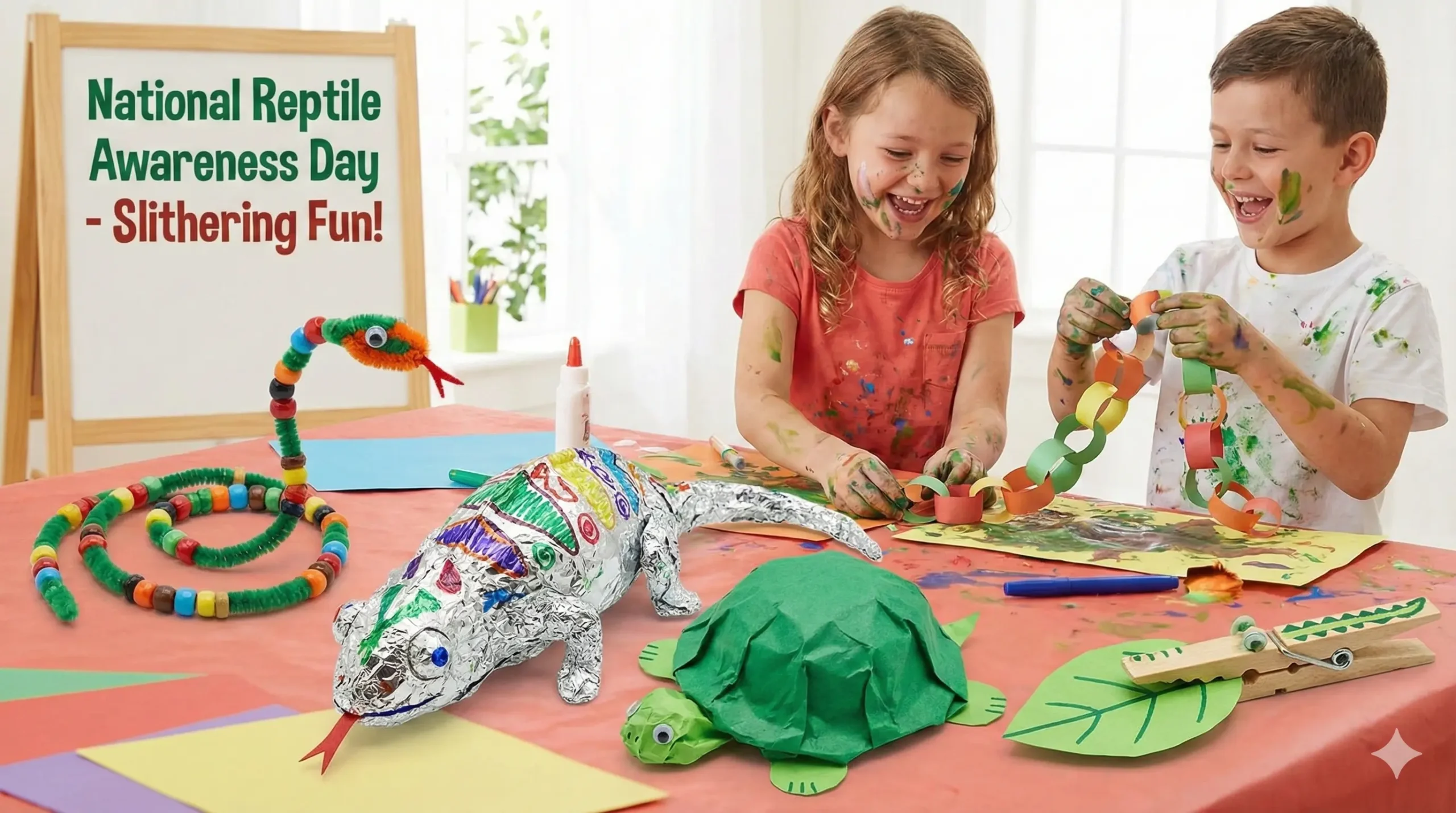
1. Pipe Cleaner and Perler Bead Snake
This is a fantastic fine motor activity. It is easy to make a snake out of pipe cleaners, but adding beads makes it tactile and colorful.
- What you need: Pipe cleaners (chenille stems), Perler beads (or pony beads), and googly eyes.
- How to do it: Have the child thread the beads onto the pipe cleaner. They can create patterns (red-black-red-black) to mimic real snakes like the Coral Snake or King Snake. Once filled, bend the end to hold the beads in place and curl the pipe cleaner to make it look like it’s slithering.
2. Foil Art Chameleon
Inspired by Eric Carle’s The Mixed-Up Chameleon, this craft explores texture and color mixing.
- What you need: Cardboard, aluminum foil, permanent markers (Sharpies).
- How to do it: Cut a chameleon shape out of thick cardboard. Wrap the shape tightly in aluminum foil. The fun part is coloring on the foil with markers; the shiny surface makes the colors pop and blend in unique ways, mimicking the color-changing ability of a real chameleon.
3. Crumpled Paper Turtle
This is perfect for toddlers and preschoolers.
- What you need: Green construction paper, a paper plate, and glue.
- How to do it: Cut a head, four legs, and a tail from the green paper. The shell is made by taking large pieces of green tissue paper or construction paper and crumpling them up into balls. Glue these “scutes” onto a paper plate bowl. Crumpling paper is an excellent exercise for strengthening hand muscles!
4. Clothespin Chomping Crocodile
A craft that doubles as a toy!
- What you need: Wooden clothespins, green paint, pipe cleaners, and small googly eyes.
- How to do it: Paint the clothespin green. Once dry, glue a strip of red felt inside the clipping part (the mouth) and add zig-zag white paper for teeth. When you squeeze the clothespin, the crocodile’s mouth snaps open and shut!
5. Paper Chain Python
If you have a group of kids, see how long you can make this snake!
- What you need: Strips of colored paper, glue, or a stapler.
- How to do it: Create a classic paper chain by looping paper strips through one another. Add a large triangle shape at the front for the head, complete with a forked tongue. This snake moves and wiggles just like the real thing.
6. Bubble Wrap Lizard Printing
This focuses on the texture of reptile skin.
- What you need: Bubble wrap, green/brown paint, and paper.
- How to do it: Cut a lizard shape out of bubble wrap. Paint the bubbly side with different shades of green and brown. Press it onto a plain piece of white paper. When you peel it back, the print will look like it has scales!
7. Egg Carton Tortoise
Tortoises have high, dome-shaped shells, making egg cartons the perfect material.
- What you need: Empty egg carton cups, pom-poms, and paint.
- How to do it: Cut out a single cup from an egg carton. Paint it green or brown. Glue a pom-pom for the head and four smaller pom-poms for the feet. You can draw details on the shell with markers.
8. Moving Paper Plate Chameleon
A specialized craft to show how chameleons change color.
- What you need: Two paper plates, a brad pin (split pin), and paints.
- How to do it: On the top plate, cut out the silhouette of a chameleon. On the bottom plate, paint a wheel of different colors (rainbow slices). Attach the two plates in the center with a brad pin. As you spin the bottom plate, the chameleon cutout changes colors!
9. Toilet Paper Roll Rattlesnake
Don’t throw away those cardboard tubes!
- What you need: 3-4 toilet paper rolls, yarn, paint, and dried beans/rice.
- How to do it: Paint the rolls and cut them in half. Punch holes in the sides and tie them together loosely with yarn so they wiggle. For the tail segment, seal the ends and put some dried rice inside. When you shake the snake, it actually rattles!
10. Salt Dough Fossils
Combine art with paleontology.
- What you need: Flour, salt, water, and plastic reptile toys.
- How to do it: Mix equal parts salt and flour with enough water to make a dough. Roll it out into small discs. Press a plastic lizard or dinosaur toy into the dough to make an imprint. Bake or let air dry to create your own “ancient” reptile fossils.
11. Handprint Cobra
A keepsake craft that captures the size of your child’s hand.
- What you need: Paint and paper.
- How to do it: Paint the child’s hand (fingers closed) and part of their wrist. Press it onto paper. The wrist acts as the snake’s body, and the hand acts as the “hood” of the cobra. Add thumbprint eyes once dry.
12. Sock Puppet Iguana
Iguanas can grow up to 6 feet long, but this one fits on your hand.
- What you need: An old green sock, felt, and glue.
- How to do it: The toe of the sock is the head. Glue a long strip of jagged felt down the back of the sock to represent the iguana’s dorsal spines. Add felt eyes and a tongue. This is great for imaginative play.
13. Mosaic Paper Turtle
Great for teaching patience and patterns.
- What you need: Cardstock and colored paper scraps cut into small squares.
- How to do it: Draw a large turtle outline. Have the child glue the small squares of paper onto the shell area, leaving small gaps between them. This creates a mosaic effect that looks exactly like the scutes on a turtle’s shell.
14. Popsicle Stick Gecko
Geckos are famous for their sticky feet.
- What you need: Craft sticks (popsicle sticks), markers, and pipe cleaners.
- How to do it: Paint the craft stick bright green. Wrap two pipe cleaners around the stick to create four legs. Bend the ends of the pipe cleaners into little loops to look like the gecko’s sticky toe pads.
15. The “Shedding Skin” Experiment Craft
This is a science-art hybrid.
- What you need: A balloon, PVA glue, and water.
- How to do it: Inflate a long balloon (snake shape). Mix glue with a little water. Cover the balloon in tissue paper strips dipped in the glue mixture (papier-mâché style). Let it dry completely. Once dry, pop the balloon and pull it out. You now have a hollow “snake skin” just like a reptile leaves behind!
The Educational Value of Reptile Crafts
Engaging in these reptile crafts for kids is about more than just keeping them busy. It bridges the gap between fear and curiosity.
- Fine Motor Skills: Threading beads for snakes or scrunching paper for turtle shells builds hand strength essential for writing.
- Biology Awareness: As you craft, you can discuss the body parts. “Why are we putting spines on the iguana?” “Why does the chameleon need to change color?”
- Environmental Stewardship: Learning about these animals fosters empathy. When children understand that turtles need clean oceans and lizards need safe habitats, they grow up wanting to protect nature.
Conclusion
This October, celebrate National Reptile Awareness Day by bringing these cold-blooded creatures into your warm home or classroom. Whether you are building a rattling snake from recycled cardboard or painting a textured crocodile, you are helping to demystify some of the world’s most interesting animals.
Reptiles aren’t monsters; they are masterpieces of nature. Hopefully, after trying a few of these 15 interesting reptile crafts, your kids will agree that snakes, lizards, and turtles are actually pretty cool!