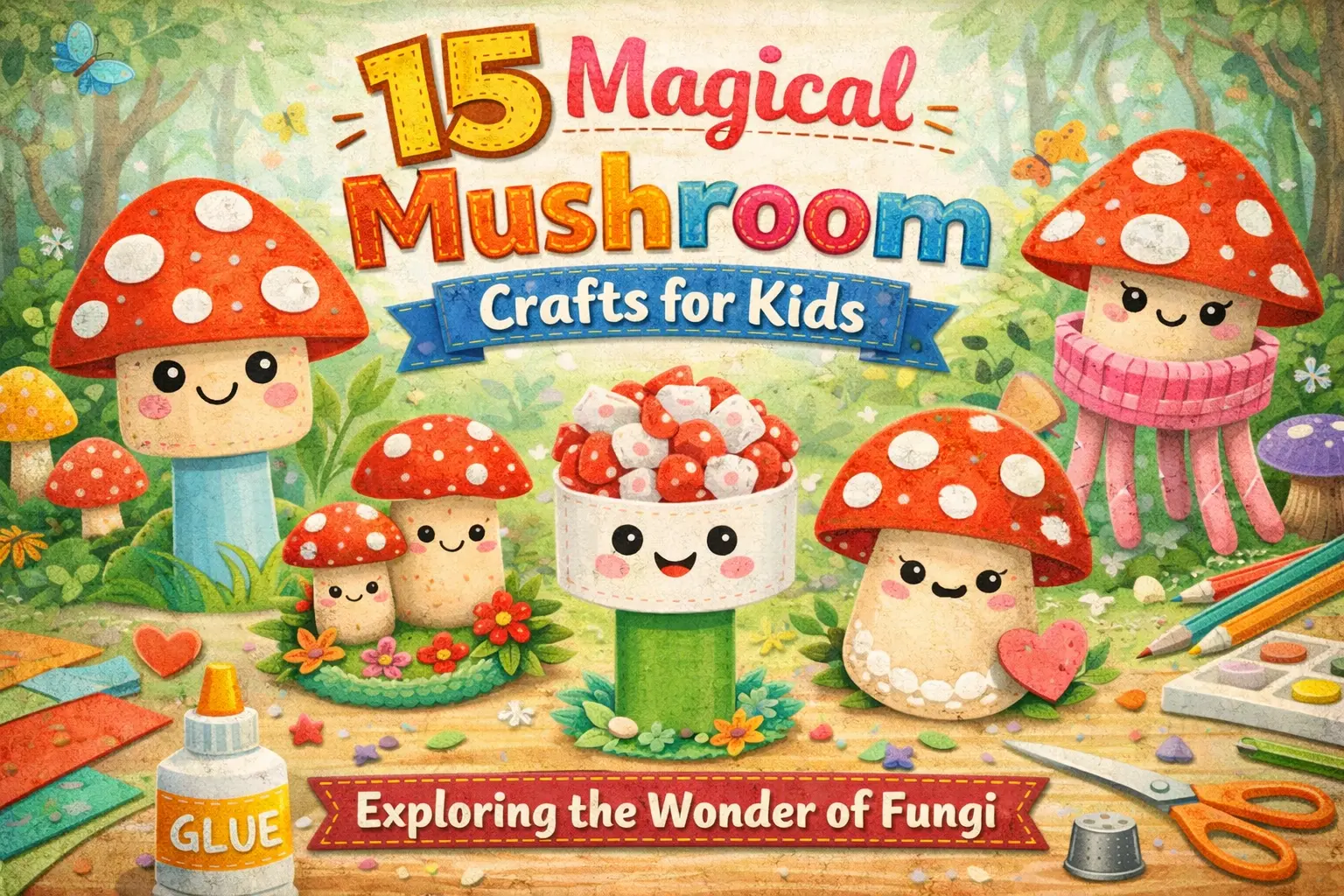
There are few things in the natural world as mysterious and versatile as mushrooms. Often associated with enchanted forests, woodland fairies, and classic video games like Super Mario, mushrooms are a fascinating subject for both scientists and artists. They serve as food, natural pesticides, and even eco-friendly packaging material. Some glow in the dark, while others are master builders of the earth’s largest networks.
Because they come in so many “alter egos”—from the friendly red-and-white toadstool to the bioluminescent “electric mushroom”—they make for incredible crafting inspiration. In this guide, we will explore 15 magical mushroom crafts for kids using recycled materials like egg cartons, paper cups, and clay. Along the way, we’ll uncover mind-blowing facts about these unique organisms.
Mind-Blowing Facts About Mushrooms
Before you pick up your scissors, let’s look at why mushrooms are the “superheroes” of the forest:
- Earth’s Largest Organism: Most people think a Blue Whale or an Elephant is the largest living thing. However, the title actually belongs to a single Honey Mushroom in Oregon that spreads across 2,385 acres. That is nearly 1,700 football fields!
- The Vitamin D Factory: Mushrooms are the only item in the produce section that can produce Vitamin D when exposed to sunlight, much like human skin.
- Eco-Friendly Packaging: Did you know mushrooms are being used to create packaging that decomposes in just 45 days? This “mushroom foam” is a sustainable alternative to Styrofoam, which takes thousands of years to break down.
- Glow-in-the-Dark Magic: Some species are bioluminescent. They glow so brightly in the dark that they have been used by travelers as natural torches to light their way through the woods.
- The Price of Gold: The world’s most expensive edible mushroom is the Yartsa Gunbu, which can cost upwards of £80,500 per kilo!
Sustainable Crafting: Why Use Recycled Materials?
Mushrooms are among the most sustainable foods to farm because they can grow on recycled cardboard and organic waste. In the spirit of sustainability, our mushroom crafts focus on upcycling items you already have at home. This not only saves money but also teaches children the importance of the circular economy—giving “trash” a second life as art.
15 Enchanting Mushroom Crafts for Kids
1. Air-Dry Clay Photo Holders
Did you know that “toadstools” and “mushrooms” are essentially the same thing? Using air-dry clay, kids can mold a thick stem and a wide, red cap. Before the clay dries, insert a coiled wire into the top. Once painted with white polka dots, this becomes a beautiful holder for polaroid photos or name cards.
2. Recycled Egg Carton Mushrooms
Egg cartons have the perfect “cup” shape for a mushroom cap. Cut out the individual cups, paint them vibrant colors, and glue them onto a rolled-up piece of scrap cardboard or a wine cork. This is a brilliant way to demonstrate that beauty can be found in everyday waste.
3. Paper Cup Toadstools
Turn a standard paper cup upside down to serve as the sturdy stem. For the cap, use a small paper bowl or a circle of red cardstock folded into a slight cone. These are large enough to serve as “fairy houses” for a woodland-themed play area.
4. Glowing “Electric” Mushrooms
Inspired by bioluminescent fungi, use neon or glow-in-the-dark paint on your crafts. If you place a small battery-operated LED tea light inside a translucent plastic cup “stem,” your mushroom craft will actually light up at night!
5. Watercolor Coffee Filter Fungi
Coffee filters are excellent for showing how mushrooms absorb moisture. Have kids paint a coffee filter with watercolors; the way the colors bleed and blend mimics the organic textures found in the wild. Fold the filter over a cardboard tube to finish.
6. Painted Stone Garden Mushrooms
Find smooth, flat stones in your backyard. Paint the larger ones as caps and the longer ones as stems. These are weatherproof and can be placed back in the garden to surprise neighbors and local “fairies.”
7. Paper Plate Mushroom Collages
For younger children, a paper plate cut in half makes the perfect mushroom cap. Let them practice their “pincer grasp” by gluing white pom-poms or paper circles onto the plate to create the classic spotted pattern.
8. Toilet Paper Roll “Woodland” Stem
Don’t throw away those cardboard rolls! They make the sturdiest stems. Kids can paint them white or tan and add “gills” (the lines under a mushroom cap) using a brown marker.
9. Stuffed Felt Mushroom Plushie
For a more advanced project, use red and white felt. Sew two circles together and stuff them with cotton to create a squishy, 3D cap. This is a great “first sewing project” for beginners.
10. Origami Folding Mushrooms
Using the Japanese art of paper folding, kids can create flat mushrooms that are perfect for decorating greeting cards or sticking into the pages of a nature journal.
11. Cupcake Liner Mushrooms
Cupcake liners already have those beautiful “gills” or ridges built in! Simply flatten a colorful liner and glue it onto a piece of paper. Add a rectangular stem below it for a quick and easy 2D art piece.
12. Spore Print Art
This is half-craft, half-science experiment. If you have a store-bought mushroom, place the cap gills-down on a piece of paper overnight. In the morning, you’ll find a beautiful, natural “spore print” that looks like a starburst.
13. Wine Cork Miniatures
If you’re making a fairy garden, wine corks are the perfect size for mushroom stems. Top them with a red button or a small circle of felt for an instant miniature woodland scene.
14. Nature-Found Branch Mushrooms
During a nature walk, collect small twigs. Use a bit of clay or playdough to create caps for the top of the twigs. This encourages kids to look at natural debris as a canvas for creativity.
15. The “Mario” Hero Mushroom
Celebrate the pop-culture side of fungi! Use a rounder shape and give your mushroom large, friendly eyes. This helps kids connect their favorite games with the real-life science of the forest.
The Educational Value of Mushroom Crafting
Engaging in these activities provides more than just a fun afternoon. It opens the door to several educational conversations:
- Biology: Discuss how mushrooms are neither plants nor animals, but belong to their own kingdom: Fungi.
- Environmental Science: Explain the role of mushrooms as “decomposers” that clean the forest floor by breaking down dead wood and leaves.
- Safety First: This is the perfect time to teach a vital safety lesson—never touch or eat a wild mushroom without an expert, as some are highly poisonous despite looking beautiful.