Did you know that 3.14% of all sailors are Pi-rates?
If you chuckled at that math joke instantly, you are among the 3.14% of my best friends! With Pi Day coming up on March 14th, get prepared to hear plenty of puns, eat delicious circular treats, and most importantly, celebrate the wonder of mathematics.
Pi, symbolized by the Greek letter π, is an irrational number whose digits go on forever without repeating. It is the magic number used to calculate the circumference and area of a circle. Because we often round Pi to 3.14, March 14th (3/14) has become the official day to celebrate.
First celebrated in 1988 by physicist Larry Shaw at the San Francisco Exploratorium, Pi Day has grown into a global event. But math doesn’t have to be boring. In fact, it can be delicious, artistic, and incredibly fun.
Here is a curated list of 15 perfect Pi Day activities for kids. These ideas mix art, STEM learning, and physical activity to ensure that kids of all ages (and their parents!) have a blast while learning.
Art & Craft: Visualizing the Infinite
Math and art are best friends. These activities help children visualize the digits of Pi in colorful and creative ways.
1. The Pi City Skyline
This is a classic favorite that turns data into a cityscape.
- The Concept: Use the digits of Pi (3.14159…) to determine the height of buildings.
- What You Need: Graph paper, black markers, and watercolors or crayons.
- How to Do It:
- Write the digits of Pi across the bottom of the graph paper (one digit per square).
- Color in the number of squares corresponding to the digit. For “3”, color 3 squares up. For “1”, color 1 square up.
- Once the “buildings” are drawn, let the kids design the sky. It creates a beautiful, randomized skyline that looks like a bustling city!
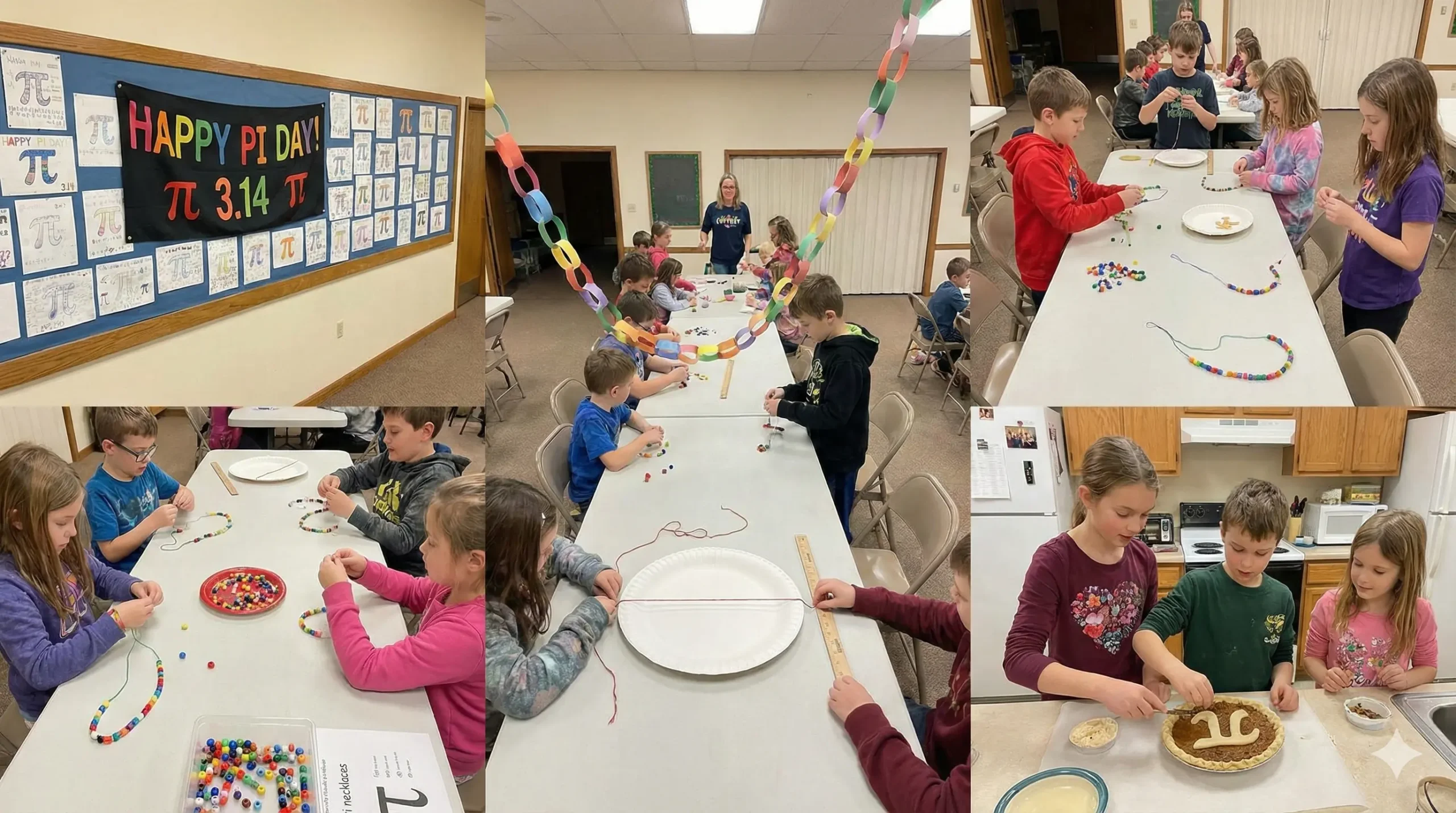
2. Paper Chain of Infinity
This is a great collaborative project for a classroom or siblings.
- The Concept: Assign a specific color of construction paper to each digit from 0 to 9.
- How to Do It:
- Create a color key (e.g., 0=White, 1=Red, 2=Blue, 3=Yellow, etc.).
- Cut strips of paper.
- Start linking them together in the order of Pi’s digits.
- Challenge: See how long you can make the chain loop around the room! It’s a visual representation of how Pi goes on forever.
3. Pi Day Beaded Necklaces
Wearable math is always a hit!
- The Concept: Similar to the paper chain, kids create jewelry based on the number sequence.
- What You Need: String and beads of 10 different colors.
- How to Do It: Write down the color code. Thread the beads to match the sequence 3.14159… Use a special charm or a larger bead to represent the decimal point.
4. Kandinsky Circle Art
Inspired by the famous artist Wassily Kandinsky, this abstract art project focuses on concentric circles.
- The Concept: Since Pi is all about circles, use this time to explore geometry through art.
- How to Do It: Give kids square pieces of paper. Have them use a compass or trace round objects (cups, bowls, glue sticks) to draw circles inside circles. Color them in contrasting bright colors. Arrange the squares together to make a quilt-like mural.
5. Dot Art (Pointillism for Pi)
This requires patience but produces stunning results.
- The Concept: Use graph paper to map out colors.
- How to Do It: Assign a color to each digit. Instead of drawing bars like the skyline, fill in each graph square with a colored dot or circle corresponding to the number. Stand back, and you’ll see a beautiful, randomized mosaic of colors.
Hands-On STEM Learning
Move away from the textbooks and get hands-on with these experiments.
6. The Great String Experiment (Proving Pi)
This is the “aha!” moment for many children.
- The Goal: To prove that the distance around a circle is roughly 3 times the distance across it.
- What You Need: Circular objects (cans, plates, frisbees), string, scissors, and a ruler.
- How to Do It:
- Measure the diameter (width) of the object with a string and cut it.
- Try to wrap that piece of string around the object. It won’t fit!
- Cut two more strings of the exact same length.
- Show the kids that it takes 3 strings plus a tiny little bit more (the .14) to wrap around the circle perfectly.
7. Pi “Buffon’s Needle” Toss
A probability experiment that is slightly advanced but fascinating.
- The Concept: You can estimate Pi by dropping sticks!
- What You Need: Toothpicks and a sheet of paper with parallel lines drawn on it (spaced apart by exactly the length of a toothpick).
- How to Do It: Drop the toothpicks randomly onto the paper. Count how many cross a line vs. how many don’t. Through a complex formula, the ratio actually approaches Pi! (Great for middle schoolers).
8. Construction Paper Pie Fractions
A visual way to understand fractions and circles.
- What You Need: Paper plates and colored construction paper.
- How to Do It: Cut “slices” of paper “pie” in different colors to represent fractions (1/2, 1/4, 1/8). Have kids mix and match to see how many fractions make a whole circle.
9. The Circle Scavenger Hunt
Perfect for younger kids who aren’t ready for complex multiplication.
- The Activity: Give them a clipboard and send them around the house or yard.
- The Mission: Find as many circular objects as possible. To advance the level, have them measure the diameter of each item they find
Language & Logic Games
Math is a language, but you can use English to celebrate it too.
10. Write in “Pilish”
This is a fun creative writing challenge.
- The Rule: You must write a sentence (or poem) where the length of each word corresponds to the digits of Pi.
- Example: “May (3) I (1) have (4) a (1) large (5) container (9)…”
- Challenge: See who can write the longest coherent story in Pilish.
11. Pi Memorization Contest
The classic Pi Day game.
- The Activity: Give the kids 5 minutes to memorize as many digits as they can.
- The Trick: Teach them to group numbers (3.14 – 159 – 265) or use a song to help. Award a prize (like a mini pie!) to the winner.
12. Pi Day Word Search
Create a custom word search or crossword puzzle.
- Vocabulary: Include words like Diameter, Radius, Circumference, Irrational, Infinite, Circle, Ratio. It reinforces the terminology they need for geometry class.
Food Fun: The Tastiest Part of the Day
It wouldn’t be Pi Day without the food!
13. Bake a Symbol Pie
You can bake a standard apple or cherry pie, but give it a math twist.
- The Twist: Instead of a lattice crust, roll out the dough and cut out the symbol π to place in the center. Or, use small cookie cutters to cut out the numbers 3, 1, and 4 to decorate the crust.
14. Fruit Pizza (Nature’s Geometry)
A healthier alternative to sugary pie.
- How to Make It: Use a slice of watermelon (a full round slice) as the base. Top it with yogurt “sauce” and arrange berries in concentric circles. It illustrates the concept of radius (center to edge) perfectly while being a tasty snack.
15. Pizza Dough Tossing
Physics in action!
- The Activity: Make homemade pizza dough.
- The Lesson: Explain centripetal force. Why does the dough become a circle when you spin it? As you spin, the dough pulls outward equally in all directions, creating a perfect circle. (Plus, you get to eat pizza afterward!)
Why Celebrating Pi Day Matters
You might wonder, why go through all this trouble for a math constant?
Celebrating educational holidays like Pi Day helps demystify mathematics. For many children, math is seen as a chore or a source of anxiety. By turning it into a festival of art, food, and games, we change the narrative. We show them that math is everywhere—in the buildings we admire, the jewelry we wear, and the food we eat.
These activities are designed to be low-cost, high-engagement, and adaptable for different age groups. Whether you have a toddler who just likes finding circles or a teenager ready to calculate the volume of a sphere, there is a place for everyone at the Pi Day table.
So, grab your rulers, your graph paper, and your appetite. Let’s make this March 14th the most irrational(ly) fun day of the year!
Happy Pi Day!
Frequently Asked Questions (FAQs)
Q: What is the best age for these activities? A: These activities span all ages! The Scavenger Hunt and Fruit Pizza are great for toddlers/preschoolers (ages 3-5). The Skyline Art and Paper Chains suit elementary kids (ages 6-10). The Buffon’s Needle and Pilish Writing are perfect for middle schoolers and teens.
Q: Do I need to be good at math to lead these activities? A: Absolutely not. These crafts focus on the concepts of shapes and sequences rather than complex calculations. The goal is engagement and fun.
Q: Why is Pi Day on March 14th? A: The date is written as 3/14 in the month/day format, which matches the first three digits of Pi (3.14).