What do the legendary artist Pablo Picasso, tennis superstar Rafael Nadal, and the mesmerizing music of Enrique Iglesias all have in common? They all hail from the sunny, vibrant, and historically rich country of Spain!
When we think of Spain, our minds often drift to golden beaches, the rhythmic stomping of Flamenco dancers, and delicious plates of Paella. But Spain is so much more than just a vacation destination. It is a land of explorers, inventors, world-class football, and artistic geniuses who changed the way we see the world.
With the National Day of Spain (Fiesta Nacional de España) approaching on October 12th, there is no better time to introduce children to this fascinating culture. Whether you are a teacher planning a multicultural unit or a parent looking for a fun weekend activity, these 15 spellbinding Spain crafts will transport your kids straight to Madrid!
5 Incredible Facts About Spain to Share with Kids
Before we dive into the paint and glitter, let’s set the stage with some trivia. Kids love knowing “cool facts” about the places they are studying.
- The Olive Oil Capital: Spain produces more olive oil than any other country in the world—even more than Italy! Nearly half of the world’s olive oil comes from Spanish olive trees.
- A European-African Bridge: Spain is the only European country that shares a physical land border with an African country (Morocco).
- The Toast of Tradition: The world’s oldest restaurant, El Restaurante Botín, is located in Madrid and has been serving food since 1725. Even Ernest Hemingway ate there!
- A Global Language: Spanish is the second most spoken native language in the world, right after Mandarin Chinese. Learning about Spain opens the door to understanding millions of people globally.
- The Unfinished Masterpiece: The Sagrada Família cathedral in Barcelona has been under construction for over 140 years. It’s a great lesson for kids that great art takes time!
Now, let’s grab our scissors and glue and explore the “Land of Passion” through these creative projects.
1. Gaudi-Inspired Mosaic Lizards
Antoni Gaudí was a famous Spanish architect known for his colorful, nature-inspired works in Barcelona. His most famous mosaic sculpture is “El Drac,” the salamander in Park Güell.
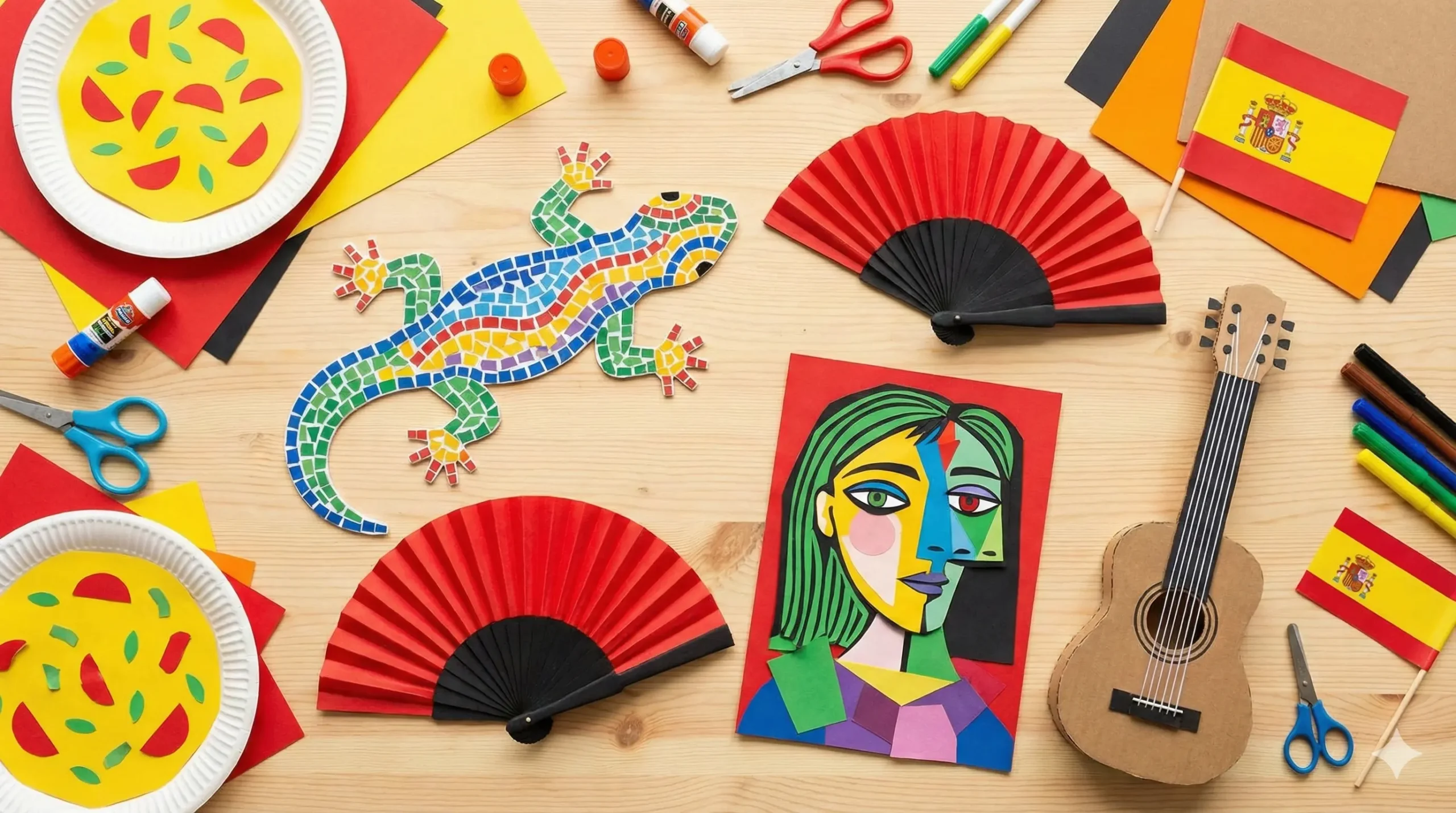
- The Craft: Draw a lizard outline on a piece of cardstock. Instead of coloring it in, have kids cut small squares of different colored construction paper (or use foam stickers). Glue these squares onto the lizard to create a “trencadís” (broken tile) mosaic effect.
- Learning Moment: Discuss how breaking things (like tiles) can sometimes be used to make something new and beautiful.
2. DIY Flamenco Hand Fans (Abanicos)
The Abanico is not just for cooling down; it is a language of its own in Spain. Ladies used to use fans to send secret messages!
- The Craft: Take a standard paper plate, cut it in half, and decorate it with bold red and black markers. Glue lace along the curved edge for an authentic look. Tape a popsicle stick to the bottom corner for a handle.
- Activity: Teach the kids simple fan movements. Fanning fast means “I am engaged,” while fanning slowly means “I am married.”
3. Pablo Picasso “Cubism” Portraits
Picasso is perhaps Spain’s most famous artist. He invented Cubism, a style where you look at an object from many angles at once.
- The Craft: Have kids draw a face shape. Then, cut out eyes, noses, and mouths from magazines. The rule is: they must glue them in the “wrong” places! Put an eye on the chin or a nose on the forehead.
- Why it’s great: It teaches children that art doesn’t have to be perfect or realistic to be amazing.
4. Cardboard Spanish Guitars
Music is the heartbeat of Spain. The classical guitar (or Spanish guitar) is essential to the culture.
- The Craft: Cut a guitar shape out of a cereal box. Use a paper towel roll for the neck. Stretch rubber bands across the hole in the body to create “strings” that actually make a sound when plucked. Decorate with markers.
5. The Red Carnation (Clavel)
The red carnation is the national flower of Spain and is often worn in the hair of Flamenco dancers.
- The Craft: Use red tissue paper. Stack several layers, fold them like an accordion, and tie the center with a pipe cleaner. Fluff out the layers to create a blooming red flower. These can be turned into hair clips or brooches.
6. Don Quixote’s Windmills
Don Quixote is the most famous Spanish novel. The hero famously fights windmills, thinking they are giants.
- The Craft: Use a toilet paper roll as the base of the tower. Make a cone roof from paper. Create the blades using two popsicle sticks glued in a cross shape. Attach the blades to the tower using a brass fastener (split pin) so they can actually spin!
7. Spanish Flag Suncatcher
The Spanish flag is bold and bright with horizontal stripes: red, yellow, and red.
- The Craft: Cut a rectangular frame from black paper. Stick a piece of clear contact paper (sticky side up) to the frame. Have toddlers tear pieces of red and yellow tissue paper and stick them onto the contact paper to mimic the flag’s stripes. Hang it in the window.
8. Castanets (Click-Clackers)
Castanets are percussion instruments used in Spanish folklore music.
- The Craft: Cut a strip of thick cardboard. Fold it in half. Glue a metal bottle cap or a button on the inside of each end. When you squeeze the cardboard, the caps should click together. Decorate the outside with polka dots!
9. Salvador Dalí’s Melting Clocks
Dalí was a Spanish surrealist painter known for his weird and wonderful images, like melting clocks.
- The Craft: Use paper plates to make clocks. Draw the numbers on the edges. Then, cut a slit in the plate or wet it slightly so you can bend and warp the plate over the edge of a table or a cardboard box. Paint it to look like it is “dripping.”
10. The Bull Silhouette (El Toro)
While bullfighting is a controversial topic today, the silhouette of the bull remains an iconic symbol of Spain (often seen on billboards).
- The Craft: Focus on the animal, not the fight. Create a “friendly bull” using black construction paper. Use white pipe cleaners for the horns and add a ring of flowers around its neck (like the story of Ferdinand the Bull).
- Book Connection: This is the perfect time to read The Story of Ferdinand, a classic book about a Spanish bull who loved flowers more than fighting.
11. Paella Paper Plate Feast
Paella is the most famous Spanish dish, originating from Valencia.
- The Craft: Give kids a paper plate (the pan). Have them cut out “ingredients” from colored paper: yellow scraps for saffron rice, pink shapes for shrimp, green for peas, and red for peppers. Glue them all onto the plate to serve a paper feast.
12. Soccer Jersey Design (La Liga)
Football (soccer) is almost a religion in Spain. Teams like Real Madrid and FC Barcelona are globally loved.
- The Craft: Print a blank T-shirt outline. Let kids design their own Spanish football team jersey. They must choose a team name, a logo, and a color scheme.
13. Christopher Columbus’s Ship (Santa Maria)
On October 12, 1492, Christopher Columbus (sailing for Spain) arrived in the Americas. This is the origin of the National Day date.
- The Craft: Use a walnut shell half as the boat hull. Use a toothpick for the mast and a small white paper triangle for the sail. Draw a red cross on the sail to represent the Spanish expedition. Float them in a bowl of water!
14. Mosaic Paper Tiles (Azulejos)
Spain, especially the Andalusia region, is famous for stunning blue and white ceramic tiles called Azulejos.
- The Craft: Cut white paper into squares (4×4 inches). Give kids only blue markers or blue paint. Ask them to create symmetrical geometric patterns. When you put all the kids’ squares together on a wall, it looks like a beautiful Spanish palace wall.
15. The Sagrada Família Model
As mentioned earlier, this cathedral is a masterpiece.
- The Craft: This is a STEM building challenge. Give kids cups, paper towel rolls, and cardboard cones. Challenge them to build the tallest, most intricate tower they can, mimicking the spires of the Barcelona cathedral. Drizzle PVA glue mixed with sand over it to give it a “stone” texture.
Detailed Tutorial: Making a Recycled “Mosaic Lizard”
Let’s zoom in on one of the most artistic crafts from the list. This project is eco-friendly and teaches color theory.
Supplies Needed:
- Cardboard (from an old cereal box).
- Old magazines or colored flyers (for the mosaic tiles).
- Scissors and Glue Stick.
- Pencil.
- Googly eyes (optional).
Step-by-Step Instructions:
- Draw the Outline: On the cardboard, draw a curvy S-shaped lizard. Give it a long tail and four legs. Cut out this silhouette.
- Prepare the “Tiles”: Instead of buying paper, look through old magazines. Find pages that have large blocks of color (blue sky, green grass, yellow ads). Cut these pages into small squares or triangles (about 1cm wide).
- Sort the Colors: This is great for younger kids. Put all the blues in one pile, greens in another, etc.
- The Mosaic Process: Start gluing the paper tiles onto the lizard. Leave a tiny gap between each piece of paper to let the cardboard show through—this looks like the “grout” between real tiles.
- Patterns: Encourage kids to make stripes or spots. Maybe the lizard has blue feet and a green back?
- The Finish: Once covered, trim any paper hanging off the edges. Add googly eyes for a fun touch!
Why Cultural Crafts Matter
Celebrating the National Day of Spain through crafts is about more than just keeping hands busy. It is about opening minds.
When a child makes a Castanet, they aren’t just folding cardboard; they are hearing the rhythm of a culture. When they glue a Picasso face, they are learning that it is okay to see the world differently.
Spain is a country that embraces life with passion, color, and history. By bringing these elements into your home or classroom, you are helping raise global citizens who appreciate the beauty of diversity.So, on October 12th, put on some guitar music, eat some olives, and enjoy these masterpieces. ¡Viva España!