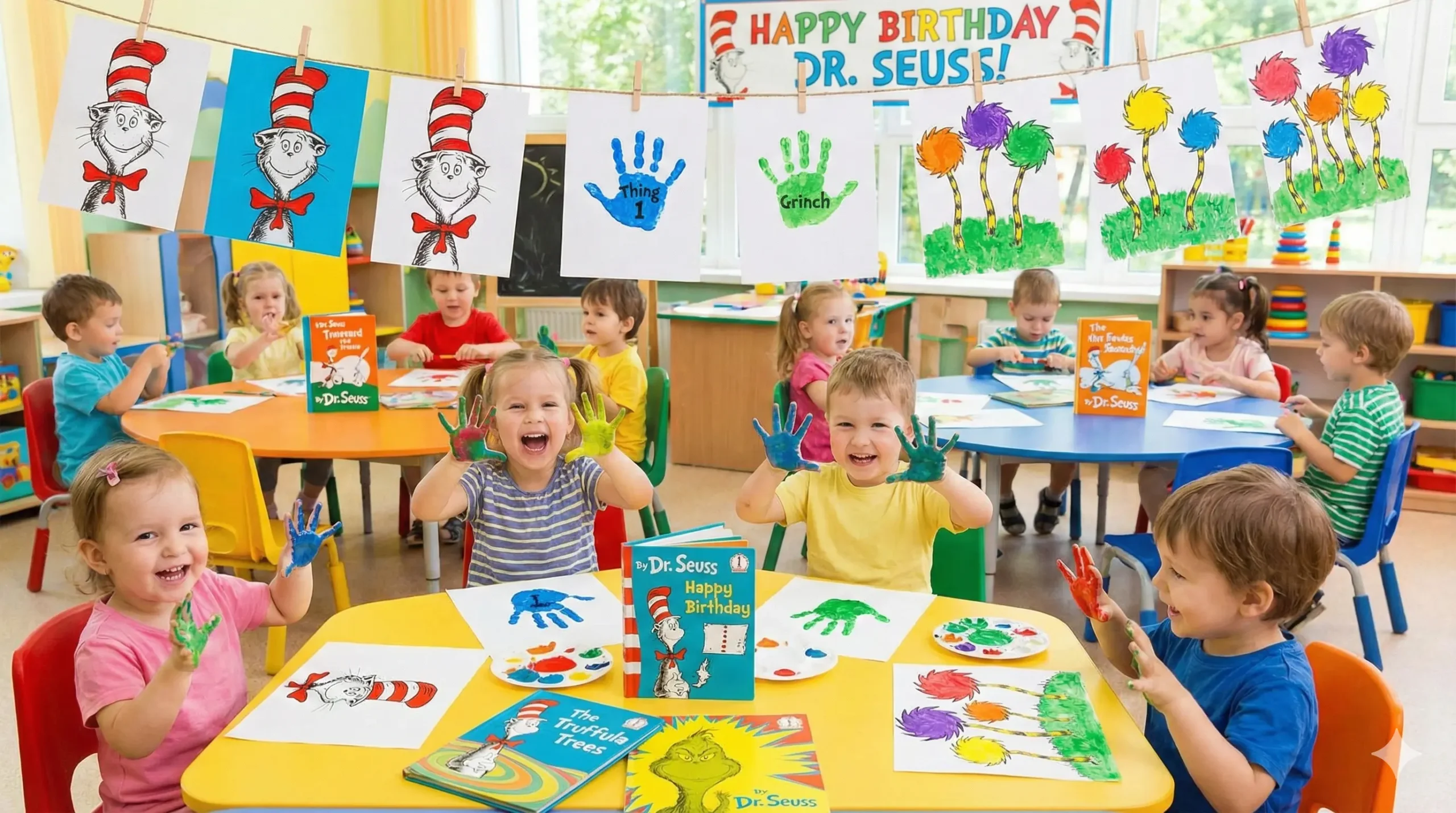
Every year on March 2nd, classrooms and living rooms across the country burst into a riot of colors, rhymes, and silly characters. It is the birthday of the legendary Dr. Seuss (Theodor Seuss Geisel), a day that has evolved into a nationwide movement known as National Read Across America Day.
While reading the books is the main event, hands-on learning is what solidifies the magic for young children. Toddlers and preschoolers learn best when they can touch, feel, and create. That is where the magic of handprint crafts comes in.
There is something undeniably special about capturing a child’s handprint. It transforms a simple afternoon art project into a treasured keepsake that freezes a moment in time. When you combine those tiny hands with the timeless characters of Dr. Seuss, you get a recipe for educational fun that parents and teachers love.
Below, we have curated 15 simple, creative, and adorable Seuss handprint crafts. These activities are designed to pair perfectly with your favorite Seuss books, helping to bring the stories to life through art.
Why Pair Crafts with Reading?
Before we dive into the glue and paint, let’s talk about why this combination is so powerful for childhood development.
- Sensory Engagement: Handprint crafts are tactile. The feeling of cool paint on warm hands stimulates sensory processing.
- Comprehension: Creating a character (like the Grinch or the Lorax) helps children recall details from the story.
- Fine Motor Skills: Cutting, pasting, and guiding a paintbrush are excellent exercises for developing hand-eye coordination.
- Emotional Bonding: These crafts require adult assistance, creating a perfect opportunity for one-on-one bonding time.
Essential Supplies You Will Need
You don’t need a professional art studio to make these masterpieces. Here is a basic checklist:
- Washable Tempera Paint: Essential for handprints (and easy cleanup!).
- Cardstock or Construction Paper: White, blue, red, and green are the staples.
- Black Sharpie or Marker: For outlining and drawing faces.
- Googly Eyes: To add that zany Seuss personality.
- Glue Stick: For assembling paper parts.
- Baby Wipes: Pro-tip: Keep these nearby for quick paint removal before the hand touches the furniture!
Category 1: The Classics (Cat in the Hat & Friends)
1. The Mischievous Thing 1 & Thing 2
This is perhaps the most iconic handprint craft of all.
- The Concept: Paint the palm of the hand white and the fingers a bright turquoise blue. Press it onto red paper.
- The Detail: The palm becomes the face, and the blue fingers represent that wild, gravity-defying hair. Once dry, draw on the mischievous smiles and glue a “Thing 1” circle on the red paper below the palm.
- Book Pairing: The Cat in the Hat
2. The Cat in the Hat
Instead of the whole cat, we focus on his most famous feature.
- The Concept: Paint the child’s palm white and the fingers in alternating red and white stripes.
- The Detail: The striped fingers become the tall stovepipe hat, while the white palm is the Cat’s face. Add black whiskers and a small black nose.
- Book Pairing: The Cat in the Hat
3. Fish in a Bowl
“One fish, two fish, red fish, blue fish.” This craft is great for teaching colors.
- The Concept: Create horizontal handprints in red and blue paint on a white paper plate (the bowl).
- The Detail: The thumb becomes the top fin, and the fingers are the tail. Draw bubbles rising from the fish mouths.
- Book Pairing: One Fish Two Fish Red Fish Blue Fish
Category 2: The Environmental & Nature Collection
4. The Lorax’s Face
He speaks for the trees, and your child can speak for the art!
- The Concept: This uses an orange handprint. Paint the palm and fingers orange.
- The Detail: The handprint serves as the Lorax’s body. The key here is to cut out a large, fluffy yellow mustache and yellow eyebrows from construction paper and glue them onto the dried handprint. Add big eyes to capture his worried expression.
- Book Pairing: The Lorax
5. Truffula Trees
A handprint craft that looks like a beautiful abstract forest.
- The Concept: Use the child’s hand to create the tuft of the tree. Paint the hand in bright, non-natural colors like pink, purple, and bright yellow.
- The Detail: Press the hand onto the top of a drawn black-and-white striped trunk (the Truffula trunk). The fingers splayed out look exactly like the soft tufts of the trees.
- Book Pairing: The Lorax
6. Horton the Elephant
“A person’s a person, no matter how small.”
- The Concept: Use grey paint. Paint the hand grey and press it horizontally.
- The Detail: The thumb acts as the trunk, and the four fingers are the elephant’s legs. Cut out a large grey ear shape from paper and glue it on. Don’t forget to glue a tiny pink pom-pom or speck of paint on the end of the “trunk” (thumb) to represent the clover with the Who!
- Book Pairing: Horton Hears a Who
Category 3: Holiday & Villain Fun
7. The Grinch
The Grinch is a favorite year-round, not just at Christmas.
- The Concept: Paint the hand green. Press it down with the fingers pointing downward.
- The Detail: The palm is the face (wearing a red paper hat glued on top), and the fingers become the Grinch’s scruffy neck beard. Use a black marker to draw his cynical smile and yellow eyes.
- Book Pairing: How the Grinch Stole Christmas
8. Max the Dog
Every villain needs a sidekick.
- The Concept: A brown handprint pressed horizontally.
- The Detail: The thumb is the tail, and the pinky is the head. Draw a single antler tied to the “head” finger with a black thread line. It’s simple but instantly recognizable.
- Book Pairing: How the Grinch Stole Christmas
Category 4: Learning & Rhyming
9. Fox in Socks
This book is a tongue twister, and the craft is a color mixer.
- The Concept: Paint the hand orange.
- The Detail: Before pressing the hand down, wipe the paint off the fingertips and replace it with blue paint. When pressed, you get an orange fox wearing blue socks! Add triangular paper ears to the top of the palm.
- Book Pairing: Fox in Socks
10. Put Me in the Zoo Leopard
A great craft for discussing patterns.
- The Concept: Paint the hand bright yellow.
- The Detail: Once the yellow handprint dries, let the child use their fingerprints to add multi-colored spots (red, blue, green, violet) all over the leopard’s body.
- Book Pairing: Put Me in the Zoo (Robert Lopshire, often associated with the Seuss collection).
11. Green Eggs and Ham Plate
Okay, technically this involves fingertips, but it’s too good to miss.
- The Concept: Cut out a ham shape from green paper. Have the child place a green handprint in the center of a paper plate.
- The Detail: The green handprint represents the “Ham,” and you can use white oval paper cutouts with green thumbprints in the middle for the “Eggs.”
- Book Pairing: Green Eggs and Ham
Category 5: Inspirational & Abstract
12. Oh, The Places You’ll Go! Balloon
This is the ultimate graduation or milestone craft.
- The Concept: This craft uses the handprint as the basket of the hot air balloon.
- The Detail: Paint the hand a solid color (like blue or tan) and press it at the bottom of the page. Above it, use a sponge or circle cutouts to create the colorful swirl of the balloon. Draw lines connecting the “fingers” of the basket to the balloon.
- Book Pairing: Oh, The Places You’ll Go!
13. The Sneetches
A lesson in inclusivity.
- The Concept: A yellow handprint body.
- The Detail: The distinguishing feature of the Star-Belly Sneetches is, well, the star. Once the yellow handprint is dry, glue a green star onto the center of the palm (the belly). You can make some with stars and some without to teach the lesson of the book.
- Book Pairing: The Sneetches
14. Yertle the Turtle Stack
This is a fun group project or one for a child who loves messy hands.
- The Concept: Horizontal green handprints.
- The Detail: Stack the handprints one on top of the other to recreate the tower of turtles. The bottom handprint is Mack. Draw shell patterns on the palms and little turtle heads sticking out from the thumbs.
- Book Pairing: Yertle the Turtle
15. The Alphabet “A, B, C”
Dr. Seuss’s ABC book is a staple.
- The Concept: Choose a letter character, like the “Zizzer-Zazzer-Zuzz.”
- The Detail: Create a wild, multi-colored handprint with messy hair (feathers glued to the fingers) to represent the imaginative creatures found in the alphabet book.
- Book Pairing: Dr. Seuss’s ABC
Tips for the Perfect Handprint
If you have ever tried to get a clear handprint from a wiggly toddler, you know it can be a challenge! Here are three tips to ensure success:
- The “High Five” Technique: Don’t grab their hand and force it down. Instead, paint their hand and ask them to give the paper a “High Five.” It feels like a game to them.
- Use Cardstock: Regular printer paper often crinkles when wet with paint. Heavy cardstock will hold the shape and look better when framed.
- Dry Time is Key: It is tempting to add the eyes and smiles immediately, but wait until the paint is fully dry. Otherwise, the marker will bleed, and the googly eyes won’t stick.
Conclusion
Dr. Seuss once wrote, “You have brains in your head. You have feet in your shoes. You can steer yourself any direction you choose.”
This March, steer your children toward creativity. These 15 Seuss handprint crafts are more than just art projects; they are memories in the making. They bridge the gap between the fantastical world of reading and the physical world of creating.
So, grab a book, open the paint, and prepare for a little bit of messy, magical fun. Whether you are making a Grinch, a Lorax, or a red fish, you are celebrating the joy of imagination—and that is exactly what Dr. Seuss would have wanted.
Happy Birthday, Dr. Seuss!
Frequently Asked Questions (FAQ)
Q: What is the best age for these crafts? A: These crafts are ideal for toddlers (ages 1-3) and preschoolers (ages 3-5). However, early elementary students (ages 6-8) also enjoy them, as they can add more detailed drawings and independent cutting.
Q: Is paint safe for babies? A: Always check the label. Look for “Non-Toxic” and “Washable” tempera paints or finger paints specifically designed for young children.
Q: Can I use ink pads instead of paint? A: Yes! Large washable ink pads are a great, less messy alternative to paint, though the colors may not be as vibrant as acrylic or tempera paint.