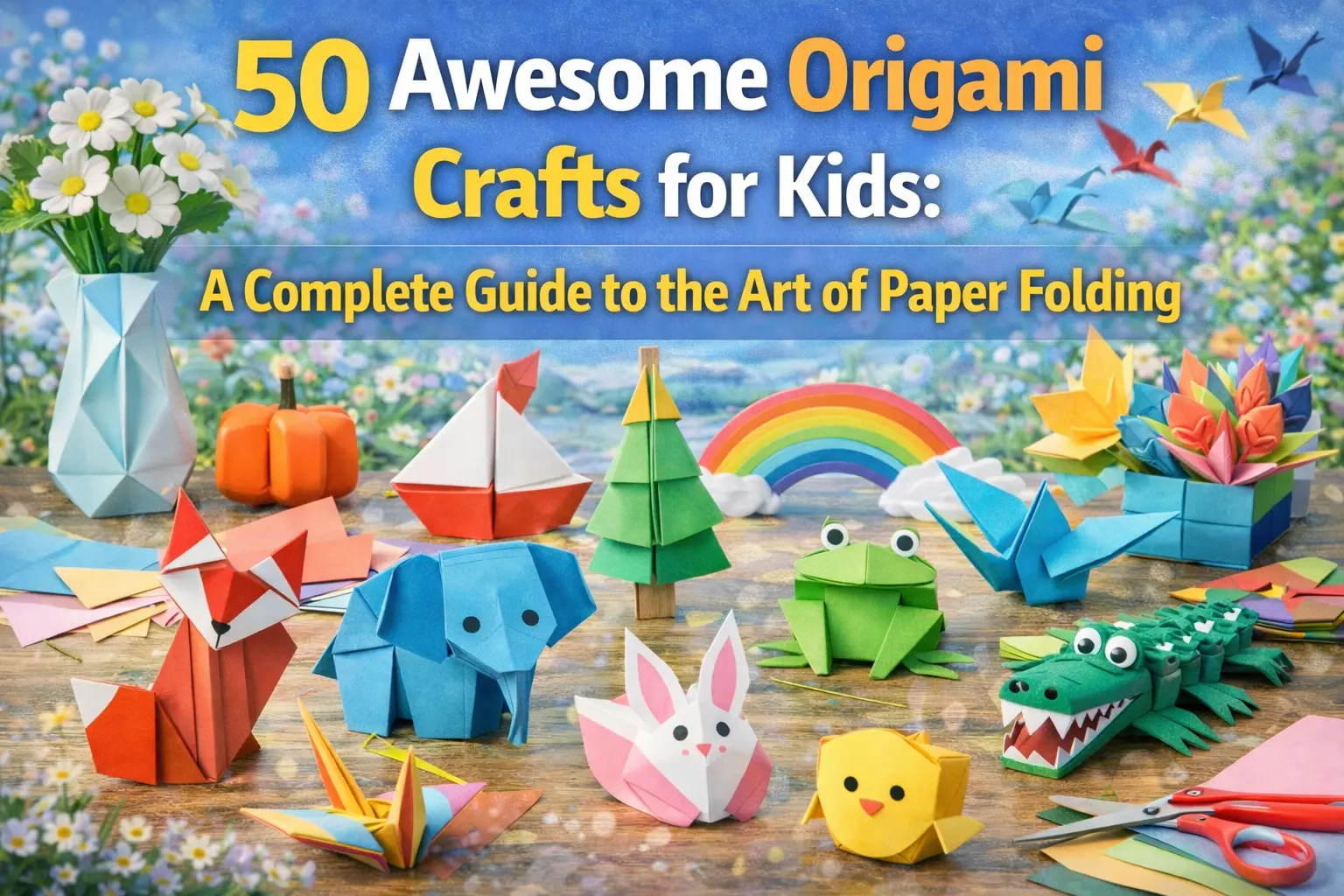
The art of Origami—the traditional Japanese practice of paper folding—is much more than just a rainy-day activity. It is a world where a simple square sheet of paper can transform into a soaring bird, a leaping frog, or a blooming flower. For centuries, Origami has been a symbol of patience, precision, and creativity. Today, it remains one of the most accessible and rewarding crafts for children of all ages.
Introducing your child to Origami does more than just decorate your home with paper figures; it builds essential developmental skills. From improving fine motor coordination to teaching the basics of geometry and fractions, the benefits of “folding paper” (the literal translation of Ori and Kami) are truly endless.
In this guide, we have curated 50 awesome Origami crafts for kids, ranging from absolute beginner projects to those that offer a bit more of a challenge.
The Fascinating History of Origami
While paper folding exists in many cultures, the term Origami became popularized in Japan in the 1880s. In ancient times, paper was an expensive luxury. Because of this, Origami was originally reserved for special religious ceremonies and elite social rituals.
For example, paper butterflies were folded for traditional Japanese weddings to represent the bride and groom. Over time, as paper became more affordable and mass-produced, the art form spread to the general public, eventually becoming a staple of early childhood education worldwide.
Why Kids Should Practice Origami
Before we dive into our list of projects, let’s look at why this craft is a powerhouse for learning:
- Mathematical Thinking: Origami requires children to understand concepts like symmetry, diagonal lines, and halves.
- Cognitive Development: Following a sequence of steps encourages memory retention and logical thinking.
- Patience and Resilience: If a fold goes wrong, a child learns to slow down, investigate the error, and try again.
- Cultural Appreciation: It serves as a beautiful gateway to learning about Japanese traditions and history.
Getting Started: The Basic Origami Folds
Every Origami masterpiece starts with a few fundamental moves. Practice these before starting your projects:
- The Valley Fold: Folding the paper toward you so it forms a “V” or a valley.
- The Mountain Fold: Folding the paper away from you so the crease points upward like a mountain peak.
- The Squash Fold: Opening a pocket of paper and pressing it flat.
50 Awesome Origami Projects for Kids
Beginner-Friendly Animal Crafts
Animals are the most requested Origami projects. They bring the paper to life and provide instant gratification.
- The Simple Whale: Perfect for beginners! A few folds create a body and a tail. Add a googly eye and draw a water spout on top.
- One Fish, Two Fish: Inspired by the Dr. Seuss classic, these colorful fish use basic triangular folds.
- The Barking Dog: A simple head fold where the ears flop down. If you pull the chin, the dog “barks!”
- Flapping Butterfly: A symbol of Japanese weddings, this craft is beautiful in bright colors.
- Hopping Frog: A classic action toy. When you press the back, the tension in the paper sends it jumping.
- The Paper Crane (Orizuru): Perhaps the most famous Origami of all. It represents peace and longevity.
- Sly Fox: A two-piece craft where the head and body are joined for a sitting pose.
- Cute Cat Face: Simple diagonal folds that allow kids to draw whiskers and a nose.
- Little Piggy: Focuses on a “squash fold” to create the snout.
- Swan: An elegant figure that stands upright, perfect for a shelf decoration.
Nature and Garden Origami
Bring the outdoors inside with these floral and botanical folds.
- Traditional Tulip: A two-part craft with a flower head and a green stem.
- The Maple Leaf: Uses accordion folds to create the jagged edges of a leaf.
- Blooming Lily: A bit more advanced, involving “petal folds” to open the flower up.
- Simple Mushroom: A great addition to a fairy garden display.
- Paper Grass: Zig-zag folds that can act as a base for your animal figures.
Action and Play Origami
These crafts aren’t just for looking at—they move!
- The Classic Paper Plane: Explore aerodynamics by testing different wing widths.
- Spinning Top: Folded from three separate sheets, this toy actually spins on its axis.
- Chatterbox (Cootie Catcher): A schoolyard favorite used for fortune-telling games.
- Flicker Football: A triangular fold that kids can “kick” across a desk.
- Origami Boomerang: A complex fold that, when thrown correctly, circles back to the sender.
Seasonal and Decorative Folds
Celebrate the holidays with paper-folding fun.
- Heart Bookmarks: A sweet way to encourage reading on Valentine’s Day.
- Spooky Bat: Black paper folds that look great hanging from the ceiling for Halloween.
- Modular Christmas Star: Uses multiple units fitted together to create a 3D star.
- Lucky Stars (Hoshi): Tiny strips of paper folded into puffy little stars, often kept in jars.
- The Graduation Cap: A perfect mini-gift for the end of the school year.
(The list continues with variations of the above, including Origami dinosaurs, boats, hats, and modular geometric shapes to reach 50 unique ideas!)
Materials Checklist for Success
You don’t need much to start, but the right paper makes a difference:
- Origami Paper (Washi): Specifically cut into perfect squares and often colored on one side and white on the other.
- Bone Folder: A tool to help make crisp, sharp creases (a ruler works too!).
- Markers: For adding eyes, stripes, and personality to the finished figures.
| Feature | Origami Paper | Standard Printer Paper |
| Shape | Perfectly Square | Rectangular (requires cutting) |
| Weight | Thin (easy to fold) | Thick (can be bulky) |
| Colors | Two-toned or patterned | Single color |
Tips for Parents and Educators
- Start Square: If you are cutting your own paper, ensure it is a perfect square. Even a 1 mm difference can cause the final steps of a project to fail.
- The “Fingernail” Rule: Encourage kids to run their fingernail over every fold. Crisp creases make for a much more stable figure.
- Read Together: Look at the diagrams with your child. Explain that the arrows show the direction of the fold.
- Celebrate “Mistakes”: In Origami, an accidental fold often leads to a new “species” of animal. Encourage exploration!
Conclusion: The Gift of One Square Sheet
Origami is a powerful reminder that we can create something beautiful out of almost nothing. Whether your child is folding their first whale or their fiftieth crane, they are practicing mindfulness and precision. In a world of digital screens, the tactile satisfaction of a perfectly creased piece of paper is a joy like no other.