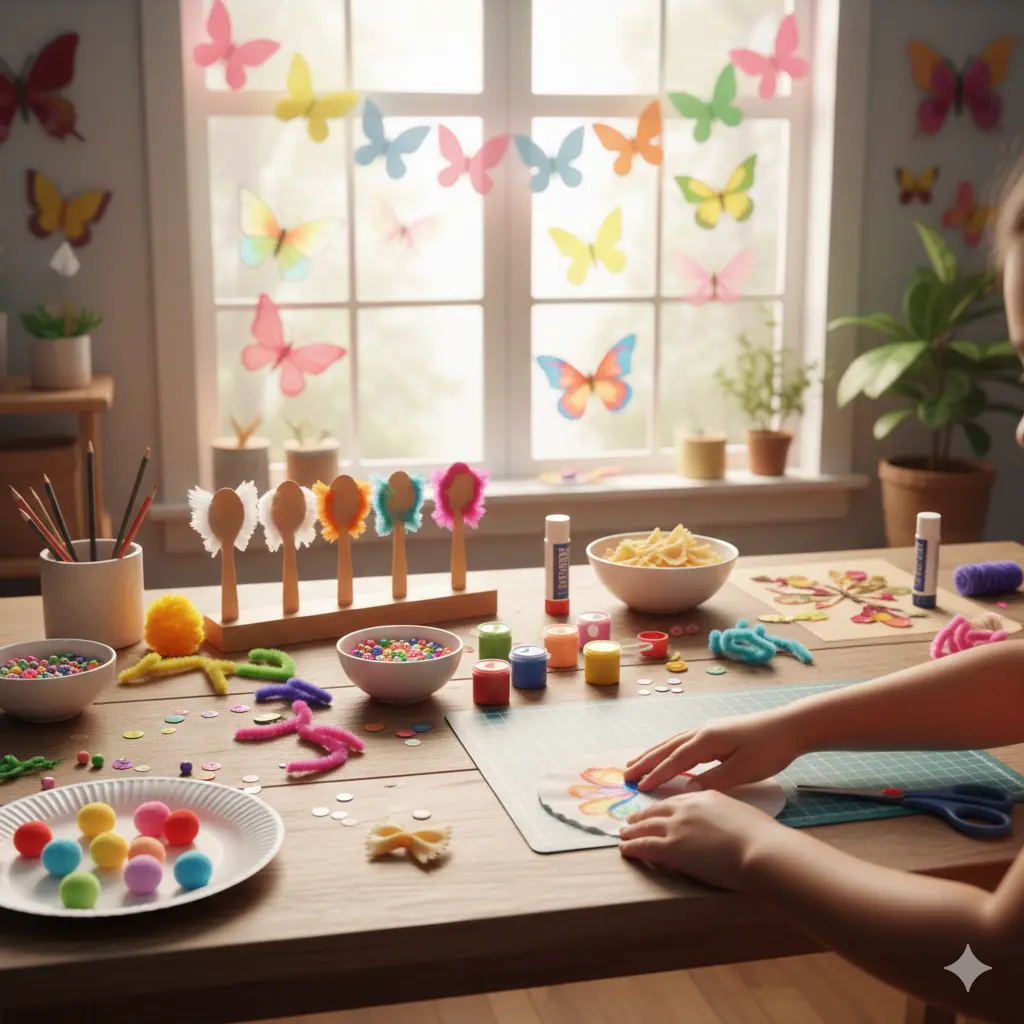
Why wait for the outdoors to come to you when you can bring the outdoors in? This craft is a wonderful excuse for a quick nature walk.
- The Activity: Have the kids collect fallen petals, interesting twigs, and green leaves.
- The Craft: Use a sturdy twig as the butterfly’s body and arrange colorful petals as the wings on a piece of cardstock. This activity teaches children to observe the diverse textures and colors found in their own backyard.
2. Handprint Wooden Spoon Puppets
Transform ordinary kitchen items into one-of-a-kind beauties.
- The Secret: Use the child’s handprints as the wings. Tracing their hands on bright construction paper and attaching them to a wooden craft spoon creates a personalized keepsake. These are perfect for afternoon puppet plays or as a heartfelt gift for grandparents.
3. Accordion-Fold Paper Butterfly Garlands
Brighten up any room with a string of fluttering friends.
- Fine Motor Focus: The repetitive folding required to make “accordion wings” is excellent for strengthening the small muscles in a child’s hands.
- The Result: String several together with twine to create a whimsical garland that brings the spirit of a summer meadow into your home.
4. Classic Coffee Filter Suncatchers
This is a “must-try” because it’s nearly impossible to mess up!
- The Science: Use washable markers to draw on a flattened coffee filter, then mist it with water. Watch as the colors bleed and blend—a great introduction to capillary action.
- Assembly: Once dry, pinch the center with a clothespin to create a vibrant, translucent butterfly that glows when taped to a sunny window.
5. Bow-Tie Pasta Art
Did you know that Farfalle pasta literally means “butterflies” in Italian?
- Sensory Play: Let kids paint dry bow-tie pasta in neon or pastel shades. Glue them onto a “garden” drawn on paper for a 3D effect that kids love to touch and show off.
6. Upcycled Toilet Paper Roll Butterflies
Don’t toss those cardboard tubes! They make the perfect sturdy bodies for 3D butterflies.
- Customization: Wrap the roll in patterned paper or paint it. Use pipe cleaners for the antennae and add googly eyes to give each butterfly a unique personality.
7. Symmetry Paint Squeeze
This is a classic art technique that feels like magic to a preschooler.
- The Method: Fold a piece of paper in half and open it back up. Squirt a few dots of paint on only one side, then fold and press. When you peel it open, you have a perfectly symmetrical butterfly.
8. Paper Plate Wing Spans
Paper plates are the perfect canvas for toddlers because of their durability.
- The Build: Cut a paper plate in half or into quarters to create large, sturdy wings. Decorate with sponge stamps, stickers, or pom-poms for a chunky, colorful craft that stands up to rough play.
9. Stained Glass Tissue Paper Butterflies
Using clear contact paper and scraps of tissue paper, kids can create “stained glass” art.
- The Look: When hung against the glass, the light shines through the layers of tissue paper, creating a beautiful mosaic effect that mimics the delicate nature of real butterfly wings.
10. Beaded Pipe Cleaner Butterflies
For older kids, threading beads is a calming and focused activity.
- The Twist: Thread colorful pony beads onto two pipe cleaners, then twist them into wing loops. This creates a tactile, flexible butterfly that can even be turned into a ring or a backpack charm.
Why Butterfly Crafts Matter: The Educational Angle
Beyond the fun, these projects serve as essential building blocks for early childhood education.
1. Fine Motor Skill Development
Almost every step in butterfly crafting—cutting wings, squeezing glue, or folding paper—requires precise movements. These actions develop the hand-eye coordination necessary for future tasks like writing and tying shoelaces.
2. Exploring STEM Concepts
- Symmetry: Butterflies are nature’s best example of symmetry. Explaining that both wings must match introduces basic geometry and math concepts.
- Metamorphosis: Use craft time to discuss the life cycle from caterpillar to chrysalis to butterfly. It’s a science lesson disguised as an art project!
3. Color and Shape Recognition
Sorting beads by color or choosing the right shape for a wing helps younger children categorize the world around them. It encourages them to use descriptive language: “I’m using the round, yellow bead for the head.”
Crafting Supply Checklist
To get started with these 20 ideas, keep a “Butterfly Box” ready with these essentials:
- Adhesives: Non-toxic school glue, glue sticks, and masking tape.
- Paper: Construction paper, cardstock, coffee filters, and tissue paper.
- Recyclables: Toilet paper rolls, egg cartons, and paper plates.
- Embellishments: Googly eyes, pipe cleaners, pom-poms, and sequins.
- Nature Finds: Twigs, pressed flowers, and leaves.
Summary of Best Butterfly Crafts by Age
| Age Group | Recommended Craft | Primary Skill |
| Toddlers (2-3) | Paper Plate Wings | Color Recognition |
| Preschool (4-5) | Symmetry Painting | Understanding Patterns |
| Elementary (6+) | Beaded Pipe Cleaners | Dexterity & Focus |
Final Thoughts: Let Their Imagination Take Flight
Butterfly crafts are more than just a way to pass a rainy afternoon. They are a celebration of change, color, and the beauty of the natural world. Whether your child is carefully threading a bead or joyfully smashing paint between two sheets of paper, they are learning that they have the power to create something beautiful.
The next time the weather keeps you indoors, remember that a little bit of paper and a whole lot of imagination are all you need to make the room flutter with life.