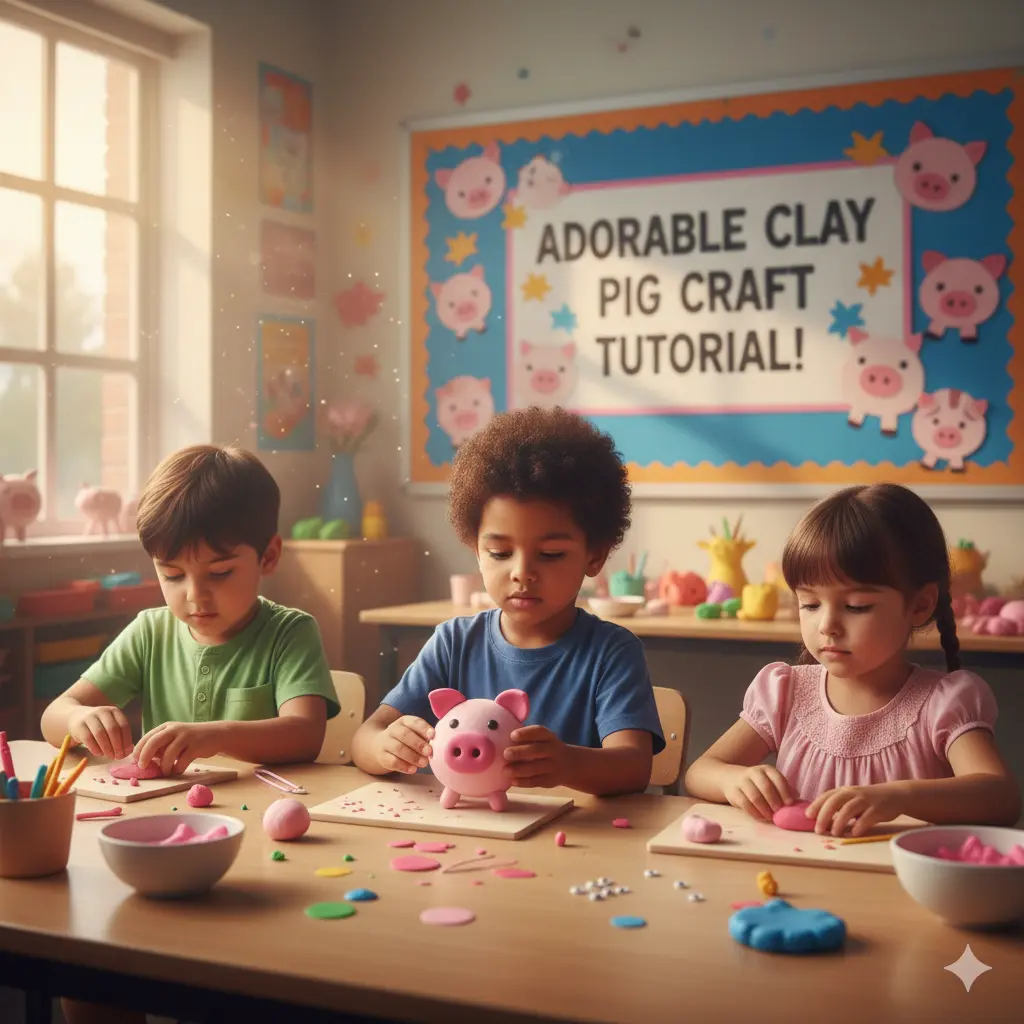
Working with clay is one of the most beneficial “tactile” activities for developing minds. It provides a unique sensory experience that other materials simply cannot match.
Developmental Benefits:
- Fine Motor Mastery: Rolling, pinching, and smoothing clay strengthens the tiny muscles in the hands and fingers.
- Hand-Eye Coordination: Aligning small pieces, like a pig’s eyes or snout, requires focus and precision.
- 3D Thinking: Children learn how to build a structure that stands on its own, helping them understand basic engineering and physics.
- Stress Relief: The squishy, moldable nature of clay is naturally therapeutic and calming for kids who may be feeling anxious or overstimulated.
Fun Pig Facts to Share While You Mold
While your little crafters are rolling their clay, keep them engaged with these “squeal-worthy” facts:
- Smart Cookies: Pigs are considered one of the most intelligent animals in the world, often outperforming dogs in problem-solving tests.
- Clean Freaks: Despite the “dirty” reputation, pigs are actually very clean animals. They keep their sleeping and eating areas strictly separate from their “bathroom” areas.
- Super Snouts: A pig’s sense of smell is roughly 2,000 times more sensitive than a human’s!
- Fast Runners: An adult pig can run up to 11 miles per hour (about 17 km/h). That’s faster than many humans can sprint!
Supplies You Will Need
For this tutorial, we recommend using Air-Dry Clay. It is mess-free, doesn’t require a kiln or oven, and hardens overnight into a durable figure.
- Light Pink Clay: This will be your primary color for the head, body, and limbs.
- Dark Pink Clay: Used for the accent pieces like the snout and inner ears.
- Black Clay (or a Black Marker): For the eyes and nostrils.
- Modeling Tools: A plastic knife or a toothpick for adding fine details.
- A Smooth Workspace: A plastic mat or parchment paper to prevent the clay from sticking to the table.
Step-by-Step Tutorial: Crafting Your Clay Pig
Step 1: Creating the Foundation
Start with your light pink clay. Divide it into two main sections. Take the first chunk and roll it between your palms until it forms a smooth, round ball about the size of a golf ball. This will be the pig’s head. Set it aside on your workspace.
Step 2: Molding the Body
Take a slightly larger piece of light pink clay and roll it into an oval or “egg” shape. This forms the pig’s sturdy body. Gently press the head onto the top of the body. If the clay is a bit dry, you can use a tiny drop of water on your finger to act as “glue” to fuse the two pieces together.
Step 3: Crafting the Snout
Switch to your dark pink clay. Pull off a small piece and roll it into a tiny ball, then flatten it slightly into a thick disk. This is the pig’s snout! Press it onto the center of the face. Use a toothpick or a small modeling tool to poke two small holes for the nostrils.
Step 4: The Signature Piggy Ears
To make the ears, create two small triangles from the light pink clay. Then, take even smaller triangles of the dark pink clay and press them onto the light pink ones to create the “inner ear” look. Attach these to the top of the head. For a cute look, you can fold the tip of one ear down slightly!
Step 5: Adding the Limbs and Tail
Roll four small, equal-sized cylinders from the light pink clay for the legs. Attach them to the bottom of the body, ensuring they are level so your pig doesn’t wobble. For the tail, roll a very thin “snake” of clay and curl it into a spiral before attaching it to the back.
Step 6: The Finishing Touches
Use two tiny dots of black clay for the eyes, placing them just above the snout. If you don’t have black clay, wait for the pink clay to dry and use a black permanent marker to draw the eyes on. Once finished, let your pig sit in a cool, dry place for 24 hours to fully harden.
Tips for Clay Crafting Success
- Avoid Cracks: If you see cracks forming while rolling, your clay might be too dry. Add a tiny bit of water to your hands and work the clay until it’s soft again.
- Scale and Proportion: Encourage kids to look at the head and body together. If the head looks too heavy, the pig might tip over! It’s a great way to talk about balance.
- Storage: Keep any leftover air-dry clay in an airtight Ziploc bag with a damp paper towel to prevent it from turning into a rock before your next project.
Conclusion
This Clay Pig Craft is more than just a desk accessory; it is a celebration of one of nature’s smartest animals. Whether you’re making it for National Pig Day or just for fun, the tactile experience of shaping clay is something every child should enjoy. Your new piggy friend is a reminder that even “trash-to-treasure” or “mud-to-magic” transformations are possible with a little creativity!